What Your Herald Dollar Actually Buys In 2026: The Two Markets Hiding Behind One Median
July 23, 2026
July 23, 2026
Ask any listing portal for the Herald median and you'll get a single number, somewhere between $739,500 and $779,000 depending on the source. That number is close to useless. On any given week in 2026 there are only eight to thirteen active listings in the 95638 ZIP, and those listings split cleanly into two products that behave nothing alike. Treating them as one market is the fastest way to write an offer that misprices the property by six figures.
The gap between the two isn't square footage or finish level. It's the paperwork attached to the dirt.
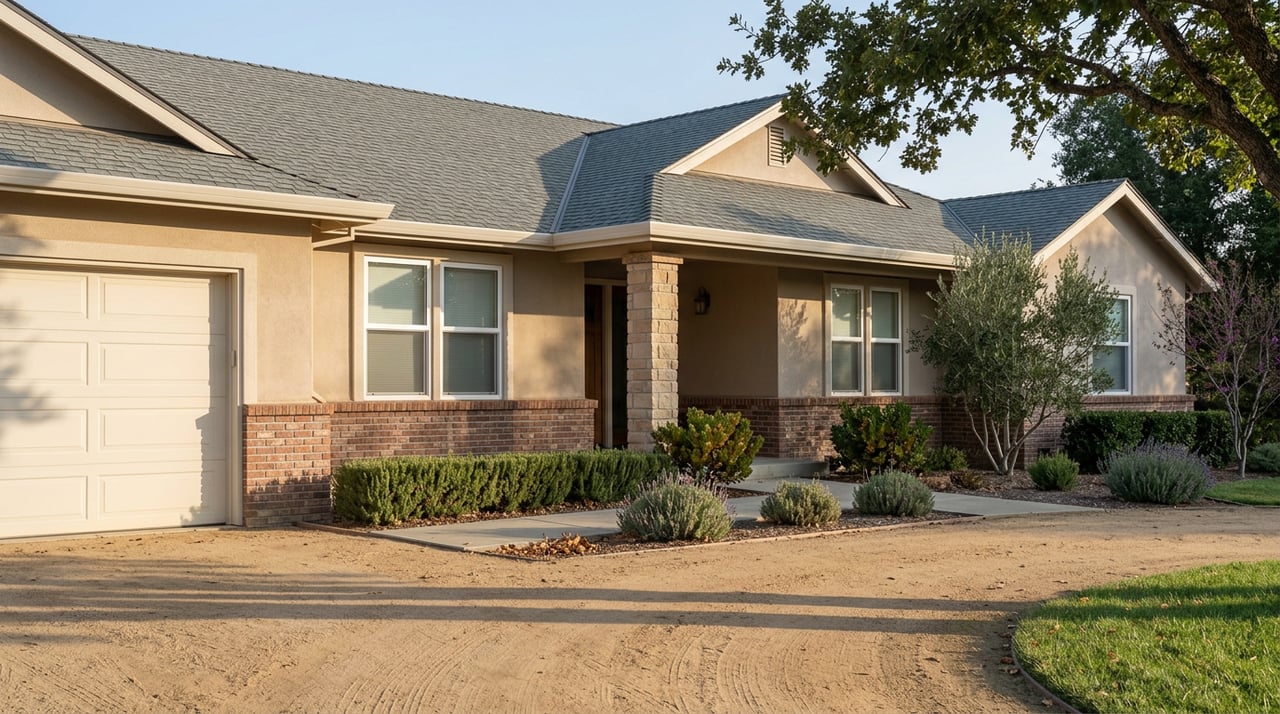
Pull up a Herald search on the MetroList feed and the same page will show you a 1-acre 2019 build on Beskeen Road next to a ten-acre custom on Kirkwood Street, next to a listing for 196.75 raw acres on Bennett Road. They print under one median, but they are two distinct products with different buyers, different lenders, and different closing timelines.
| Product | Typical Herald Example | Zoning | What the price mostly reflects |
|---|---|---|---|
| Sub-5-acre country home | 14113 Beskeen Rd, 1 acre, built 2019, around $680,000 | AR-2 or AR-5 | The house itself, well, septic, and a usable but small parcel |
| 10+ acre ranch or ag parcel | 12065 Kirkwood St, 10 acres, 2,995 sqft; a nearby 80-acre flood-irrigated ranch with two wells and an ag meter | AG-20 or land-only AR-5 | The land, water rights, outbuildings, and any active ag contract riding with the deed |
The first product competes with Galt city listings and, at the margin, with Elk Grove new builds south of Sheldon. The second competes with acreage in Wilton and southern San Joaquin County. A buyer shopping "Herald under $800K" is really shopping two different markets that happen to file under the same post office.
Here is the friction that traps out-of-area buyers. Many of Herald's larger parcels are enrolled in a California Land Conservation Act contract, commonly called a Williamson Act contract. In exchange for restricting the land to agricultural or open-space use, the parcel is assessed on its ag use value rather than its market value. The California Department of Conservation has estimated the resulting property tax savings historically fall between 20% and 75% of what a Proposition 13 assessment would produce.
That savings does not evaporate at closing. It transfers with the deed, and so do the restrictions.
A Williamson Act contract is a rolling ten-year agreement. It auto-renews every year on its anniversary date unless the landowner or the county files a Notice of Nonrenewal. Once nonrenewal is filed, the contract does not end. It winds down over the remaining nine to ten years, with the assessment climbing each year toward full Proposition 13 value. In Sacramento County, that filing is Form PER-212, processed by the Office of Planning and Environmental Review at 827 7th Street, and it must be signed by all current owners and notarized.
Read that again with a buyer's hat on. If you are buying a Williamson Act parcel and you plan to keep it in ag or open space, you inherit a tax break most of your neighbors don't get. If you are buying a Williamson Act parcel and you plan to run a non-ag use the contract doesn't allow, you are looking at either a nine-year unwind or a formal cancellation, and cancellation in California requires two specific findings by the local agency plus a cancellation fee that runs a percentage of the unrestricted market value. Sacramento County generally requires preserves of at least 100 acres, though contiguous ownerships can be combined to meet that threshold.
Very few buyers coming from Sacramento, the Bay, or Southern California price this correctly in their initial offer. The listing agent will disclose the enrollment, but the mechanics only surface when the title report and the assessor's roll cross the buyer's desk in escrow. By then the appraisal is running.
The other layer that flattens under a single median is Sacramento County's agricultural-residential and agricultural zoning designations. Two Herald parcels with identical acreage and identical asking prices can permit very different uses.
AR-5, the most common Herald designation for country homes on five acres, allows one primary residence and the same slate of permitted uses as AR-10, minus commercial feedlots. That covers the animal keeping and small-scale agriculture most Herald buyers are looking for: horses, a few head of cattle, orchard, garden, small vineyard. AR-2 works similarly at a two-acre minimum. Move up to AG-20 and the calculus changes. The 20-acre minimum is calibrated to actual agricultural use and soil productivity, and the county explicitly promotes long-term ag use through that designation. It is not a lifestyle zone with extra land attached.
A buyer who wants a private residence with a barn and a paddock is a very different buyer than one who wants to run a small vineyard or a commercial hay operation. The listings often look interchangeable in a photo carousel. The zoning code says otherwise.
The other reason the Herald median is misleading is arithmetic. Movoto reported eight active listings and a median of $367 per square foot in March 2026, down roughly 18% year over year. Redfin's countywide median for Sacramento County sat around $471,500 over the same period. Statewide, the California Association of Realtors put the April 2026 median at $914,810 with a 30-year fixed rate of 6.54%.
Herald's number is not moving because Herald's market moved 18%. It is moving because one $1.4 million ranch selling instead of one $650,000 home selling changes the median for the whole quarter. In a market this thin, the median is a mood ring.
The numbers that actually predict what a Herald property will sell for are narrower.
Compare Herald to its neighbors and the picture sharpens. Galt city listings in July 2026 posted a median list around $599,000 with days on market that Redfin and Movoto disagree on sharply, one reporting the mid-40s and the other 144. Wilton's June 2026 median list ran near $999,000, with Ranch at Clay Station sales routinely clearing seven figures on two to six-acre lots inside a gated HOA. Herald sits between those markets on price and above both on parcel size for the same dollar, but the tradeoff is real: fewer comparables, thinner buyer pools, and the Williamson Act layer on many of the larger parcels.
The county assessor's roll flags it, and the seller's disclosure package should include the contract itself. If you want to verify independently before the listing agent gets back to you, the Sacramento County Assessor's Agricultural Team at [email protected] handles LCA properties out of the American River Drive office.
Under AR-1 and AR-5, secondary uses and accessory dwellings follow the county's standard rules for agricultural-residential zones. Under AG-20, the presumption flips toward preserving ag use, and a Williamson Act contract narrows the permitted list further. Confirm the specific use with Sacramento County Planning and Environmental Review before the contingency period closes.
Water, road frontage, whether the property is inside or outside FEMA-mapped areas along the Cosumnes and Dry Creek drainages, and whether any structures on the parcel were permitted and finalized. Zoning is often the same; the improvements and the paper are what move the number.
Herald rewards buyers who slow down long enough to read the deed, the contract, and the assessor's roll before they read the listing description. If you're looking at a specific parcel and want to know which of the two markets it actually sits in, Roenspie + Johnson Real Estate Group works these Sacramento County acreage transactions every month. Contact us for a local market consultation, and we'll walk the zoning, the water, and the contract with you before you write.
We pride ourselves in providing personalized solutions that bring our clients closer to their dream properties and enhance their long-term wealth.