Beginner’s Guide To Buying Horse Property In Wilton
June 11, 2026
June 11, 2026
Buying horse property in Wilton can feel exciting right up until you realize that two parcels with the same acreage may work very differently. If you are buying your first equestrian property, you are probably balancing dreams about barns, turnout, and arena space with real questions about zoning, wells, septic, and access. The good news is that a smart, site-specific approach can help you avoid expensive surprises and choose a property that truly fits your goals. Let’s dive in.
Wilton sits within Sacramento County’s rural agricultural-residential framework, and the County specifically recognizes that this area has a larger agricultural-residential footprint and more parcel variety than some nearby rural communities. That matters because horse property here is not one-size-fits-all. A parcel’s layout, zoning, and utility setup can be just as important as the number of acres on paper.
In other words, you should not assume that “more land” automatically means “better horse property.” One parcel may have room for a barn, turnout, and trailer access, while another may be limited by setbacks, overlays, drainage, or utility conditions. In Wilton, parcel-by-parcel review is the safest way to buy.
Before you fall in love with the barn or the view, confirm exactly how the property is zoned. Sacramento County’s Agricultural-Residential zoning sequence includes AR-10, AR-5, AR-2, and AR-1, which correspond to minimum parcel sizes of 10, 5, 2, and 1 acre. These zones generally allow animals and crops, but the parcel size threshold gets tighter as you move down the sequence.
The County also notes that RD-1 is similar to AR-1 in density but does not allow general agricultural uses such as row crops or gas wells, even though incidental agricultural uses, including horses, are permitted. That distinction matters if you are thinking beyond basic horse keeping. A parcel may allow horses, but still not function like a full agricultural property.
You should also verify whether the parcel is in the unincorporated area of Sacramento County and check for any SPA, NPA, Specific Plan, Combining Zone, or PUD designation. These special layers can change setbacks and use standards. A property that looks ideal online may come with development rules that affect where you can place corrals, barns, or riding areas.
A five-acre parcel can still be a poor fit if the usable area is broken up by drainage issues, awkward access, or building restrictions. On the other hand, a smaller parcel may work well if the improvements are legal, well-placed, and supported by the site. That is why your first question should be about zoning and development standards, not just lot size.
Sacramento County sets some basic thresholds that matter right away for horse buyers. The County requires a minimum lot area of 20,000 square feet for a private stable or corral. For a commercial or public stable or corral, the minimum jumps to 3 acres.
The County also uses separate development standards for accessory structures in AG and AR zones. Depending on lot size, the combined accessory-structure area is generally capped at 5,000 square feet unless an exception applies. That can become a real limit if you want a barn, tack room, hay storage, trailer parking, and other support structures.
This is one of the biggest beginner mistakes in rural property shopping. You may find a parcel that seems big enough for horses, but it may not be big enough for the setup you actually want after setbacks and structure limits are factored in.
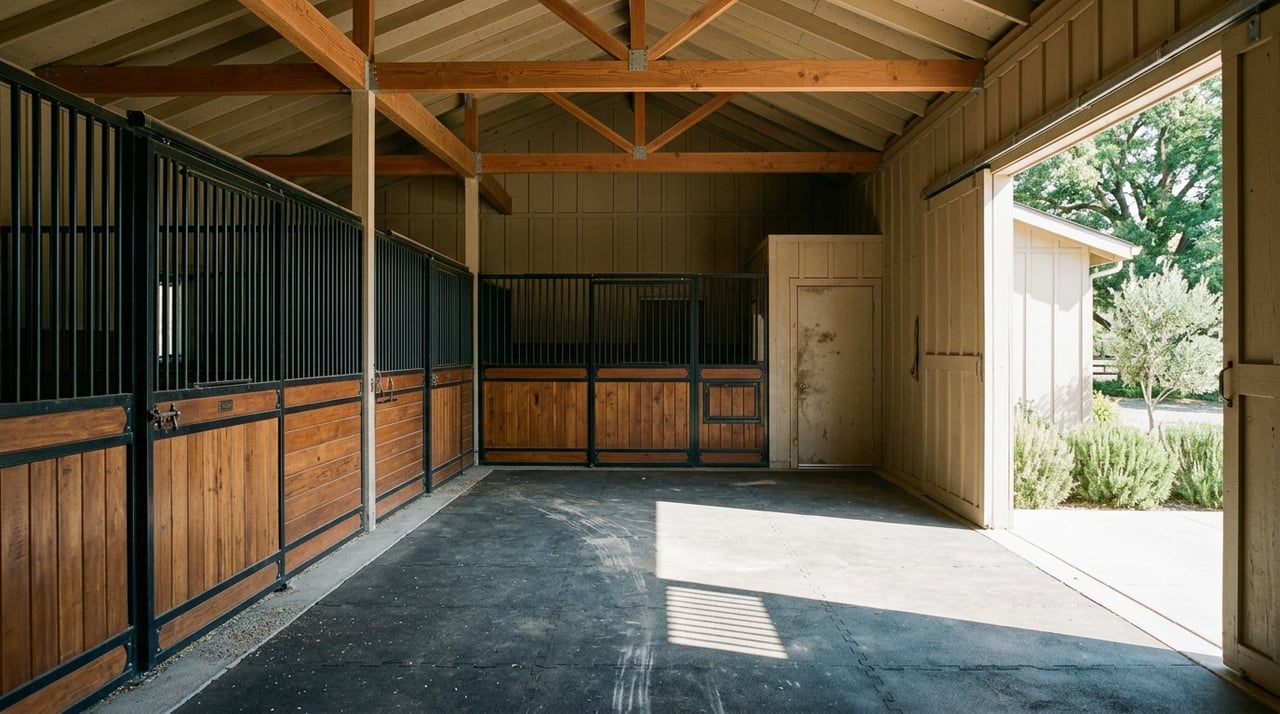
A pretty barn is not always a functional barn. For first-time buyers, it helps to focus on air flow, safety, and day-to-day workflow instead of cosmetic details.
Horse barns need good air exchange to remove moisture and maintain air quality. Poor design can create stale or damp conditions, especially in layouts where center stalls do not get enough fresh air. If you are touring a property, pay attention to how open and breathable the barn feels.
Stall size matters too. A 10-by-10-foot stall is commonly cited as a minimum for riding horses, while 12-by-12 feet or larger is generally preferred. You should also look at whether doors open safely into the aisle, whether lighting reduces deep shadows, and whether wiring is protected.
When you tour a Wilton horse property, check for:
Many first-time buyers are drawn to the look of lush pasture, but usable horse ground is about function more than appearance. In the Sacramento and San Joaquin Valleys, irrigated pasture can work well, but only when the site has the right soil, drainage, and forage plan.
High-use areas such as gates, feeders, and turnout entrances usually perform better on slightly higher ground with a slight slope for drainage. Base rock and sand may be needed to improve footing and reduce mud. If a parcel stays wet in the wrong places, everyday horse care gets harder fast.
If the property cannot support year-round grazing, a dry lot or sacrifice area may matter more than pasture looks. A common guideline is about 72 to 144 square feet per average-sized horse in a dry lot, along with access to a three-sided shelter that blocks wind and gives horses cover in poor weather. For many buyers, that kind of practical setup is more valuable than a photo-ready field.
If riding space is important to you, do not stop at the arena fence line and assume all is well. The surface you see on top is only part of the story. A usable arena needs cushion, traction, manageable dust levels, and a surface that is not overly abrasive.
Just as important, the base and drainage system are what help the footing hold up over time. If the arena develops standing water, uneven spots, or excessive dust, you may be looking at future repair costs. For beginners, this is a good reminder that horse property value comes from function, not just features.
Rural access can make or break a horse property. Even if the home and barn look great, you still need to know whether horse trailers, hay deliveries, farrier trucks, and emergency vehicles can move through the property safely.
Sacramento County’s development standards say driveway width and street design must be confirmed with the Fire Department. For dead-end driveways under 150 feet, turnarounds may be required as needed, and minimum widths vary by driveway configuration. That means access is not something to guess at.
Before you write an offer, consider:
Utilities are often one of the biggest differences between town living and rural living. In Sacramento County, well construction requires a permit before construction, and septic or OWTS construction or repair usually requires a permit as well.
The County also says that if public sewer is available within 200 feet of the property line, connection may be required. Buyers should use County records and septic mapping tools to confirm whether a parcel is served by sewer or an on-site system. You will want to know what exists, whether it was permitted, and whether the records match the property’s current setup.
If the property has an existing septic system, Sacramento County says a septic tank should typically be pumped every 3 to 5 years. That is a useful maintenance benchmark when evaluating ongoing ownership costs and system care.
Horse use comes with operating rules, not just zoning labels. Sacramento County allows riding stables, boarding stables, riding academies, and other stables and corrals, but it also regulates where they can be placed and how they are maintained.
Any corral, riding ring, or exercise yard used for horses must be enclosed. No part of it may be closer than 20 feet to any door, window, or other opening of a dwelling. Livestock fencing must contain the animals and help prevent cross-boundary damage, and dust, odor, or flies cannot be allowed to become a nuisance.
These rules are especially important when you are evaluating an existing setup. A property may have horse improvements in place, but you still need to confirm that the layout works within County standards.
If you are buying your first horse property in Wilton, due diligence should cover the legal setup and the practical setup. You want to know whether the property can support the number of horses you plan to keep and whether the existing improvements really match your goals.
Wilton stands out because it offers parcel variety within a rural setting that many horse buyers want. Sacramento County recognizes the area as a larger agricultural-residential area with more parcels than some nearby communities. That can create more opportunities to find a workable first horse property.
Still, the advantage is not that every parcel follows the same pattern. The real advantage is choice. If you compare properties carefully and review zoning, access, setbacks, and utilities in detail, Wilton can offer strong options for buyers who want space for horses without relying on assumptions.
Buying your first horse property is a big step, and the right guidance can save you time, stress, and costly surprises. If you want help comparing Wilton parcels, reviewing rural property red flags, or finding an equestrian property that fits your goals, reach out to Becky Roenspie for a local market consultation.
We pride ourselves in providing personalized solutions that bring our clients closer to their dream properties and enhance their long-term wealth.